9/70+
Nine full-time people. Seventy-plus autonomous agents. A company that runs on the function surface of a large enterprise.
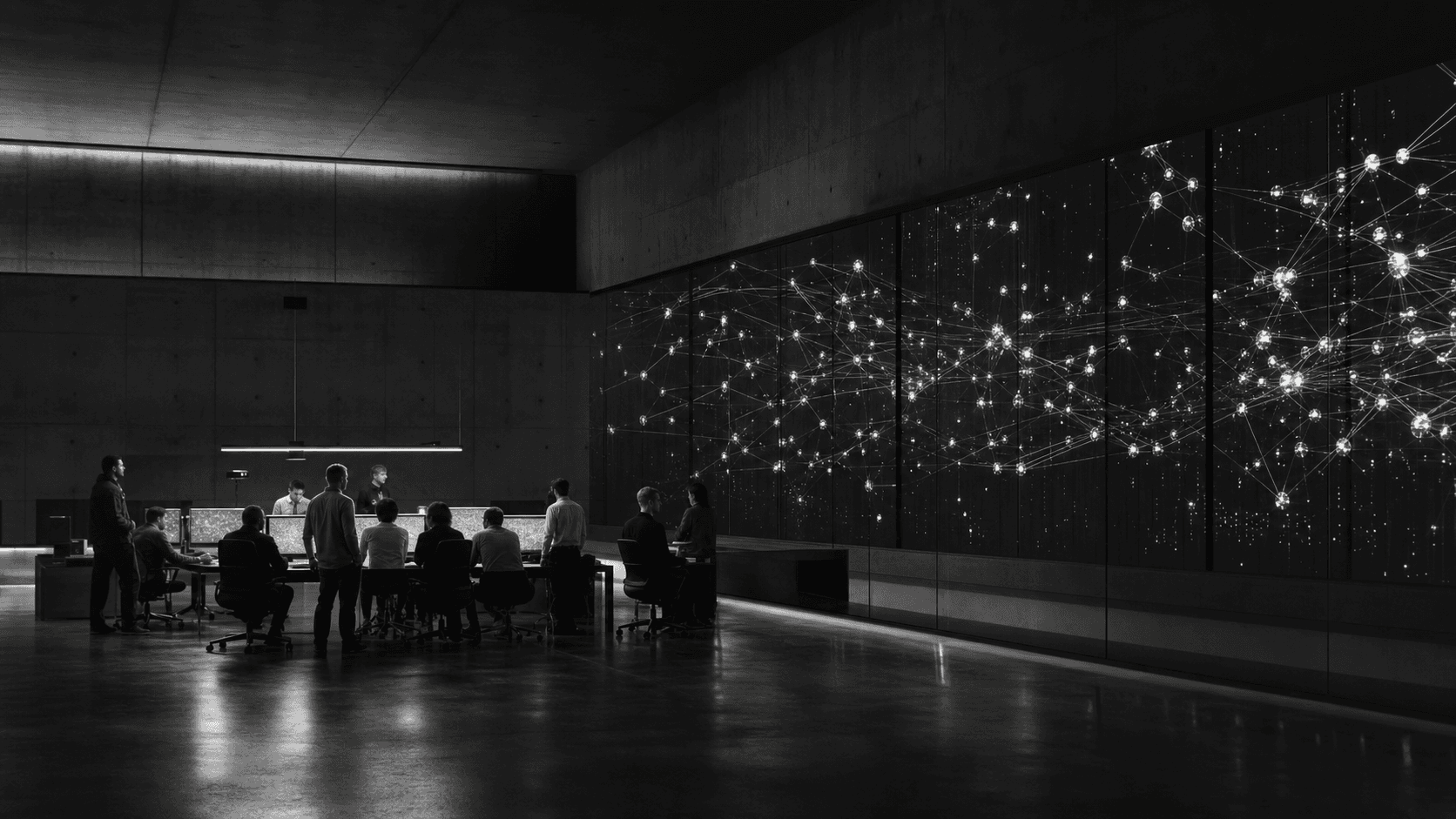
Capacity was tied to headcount.
Nine people cannot conventionally staff engineering, research, security, go-to-market, finance operations and round-the-clock monitoring. Hiring for it would add coordination cost long before it added velocity.
Turn expertise into a system.
Specialist agents were organized around clear roles, shared context, tool boundaries and visible escalation paths - the org chart of a large company, expressed as software.
Enterprise surface, small core.
Nine people remain the accountable core while seventy-plus agents hold eight business functions open continuously. The company behaves like a large one, without becoming one.
Nine people.Enterprise reach.
INFINITEWARE is a company of nine full-timers, augmented by a digital workforce of more than seventy specialized AI agents. They research, build, test, publish, monitor and improve - continuously, across every function a large organization would staff.
Not a smallcompany withAI bolted on.
It is a large company with a small human core. The difference is structural: the functions are real, permanently staffed and independently checked - they are simply not staffed by people.
A company hasa shape. Sodoes this one.
Agents are not a swarm answering prompts. They sit in tiers, they run on their own schedules, they wake on events, and every one of them inherits the same charter. Work descends through the structure and evidence climbs back up it.
- Tier 00CharterThe standing rules every agent inherits
Purpose, boundaries, tone, escalation policy, what may never be done without a person.
- Tier 01Human principalsNine accountable people
Own judgment, relationships, risk appetite and the definition of done. Named on every consequential decision.
- Tier 02OrchestratorsDecompose and route
Turn an objective into a plan, recruit the specialists it needs, hold the thread until evidence comes back.
- Tier 03SpecialistsSeventy-plus agents, eight functions
Do the work. Each has a role, a memory, a tool boundary and an owner it escalates to.
- Tier 04SystemsWhere the work lands
Repositories, mailboxes, calendars, ledgers, CRM, infrastructure. Every touch is logged.
Descending arrows carry intent. Ascending arrows carry evidence. Nothing crosses a tier without a record of who asked and what came back.
Autonomy stopsat consequence.
The system is deliberately not fully autonomous. Six gates stay closed until a named person opens them. Agents can prepare everything up to the gate, attach the evidence and wait. They cannot walk through it.
No payment, invoice or commitment leaves without a signature.
Held by Finance principalScope, price and dates are agreed by a person, not proposed by one.
Held by Engagement ownerAgents build and verify. A human approves the release.
Held by Engineering principalAnything published under the name is read by a person first.
Held by Communications principalDrafted with assistance, executed only by a named human.
Held by CEOAny widening of access is a human decision with a written reason.
Held by Security principalSpecialists,not substitutes.
Eight standing functions. The same departments a large organization would staff, held open continuously by a workforce that does not sleep.
From intentto evidence.
Receive
A human defines the objective, constraints and acceptable risk.
Decompose
A lead agent forms the plan and recruits specialist agents.
Execute
Tasks move in parallel across code, research, content and operations.
Verify
Independent agents test the work against explicit acceptance criteria.
Escalate
Ambiguity and consequential choices return to accountable humans.
Freedom hasclear edges.
Gather signals, synthesize context and surface what deserves attention.
Read- Read-only tools
- No external action
- Sources required
Create plans, code branches and candidate outputs for human or agent review.
Draft- Sandboxed creation
- Reversible work
- Review required
Complete bounded, reversible actions within explicit operational limits.
Execute- Scoped permissions
- Action logging
- Continuous checks
Route ambiguity, irreversible actions and consequential decisions to a person.
Ask- Named owner
- Evidence attached
- Human accountable
A shift thatnever ends.
Signals become briefs.
Research agents scan the market, customer feedback and product telemetry. By the time the team arrives, the noise is compressed into decisions.
Humans set direction.
The team approves priorities, adjusts constraints and assigns accountability. The system turns strategy into concurrent workstreams.
Builds move in parallel.
Engineering agents implement features while test agents challenge assumptions and security agents inspect the attack surface.
One release, many outputs.
Release notes, customer education, campaign assets, sales enablement and PR angles emerge from the same verified source.
The company keeps learning.
After people leave, the system monitors outcomes, resolves routine issues and prepares tomorrow's options, with escalation always open.

Brandingthat runsitself.
The film above was not briefed out. Direction, frames, motion, score and cut were produced inside the company by the same agent system that ships the software. The same is true of the product screenshots, the campaign stills and the launch copy - they are generated live, to the brand system, and refreshed when the product changes.
Product films and teasers assembled, scored and cut end to end.
Campaign stills, product frames and social sets generated to the brand system.
Launch narrative, release notes and channel variants from one verified source.
Packaged, scheduled and queued, with a person holding the final approval.
Marketing stopped being a queue of requests and became a standing capability. A person still approves what goes out.
Reachable likeanyone elseon the team.
Agents have mailboxes and calendars. You brief one the way you brief a colleague: send it a message, invite it to the thread, put it on the meeting. What separates them from a tool is that the scope they are trusted with keeps widening.
Read the surface, report what matters.
Draft the work, hand it back for review.
Execute bounded, reversible work alone.
Hold a standing function end to end, with a named human above it.
Autonomy is earned against evidence, one step at a time, and it can be withdrawn the same way.
The gateabove everyother gate.
Speed is worth nothing if the company leaks. Security is not a review stage near the end. It is the condition every other function operates under, and the one place where a refusal never needs justifying.
Each agent holds the narrowest tool and data scope its role can function on. Widening it is a human decision with a written reason.
The agent that reviews a change is never the agent that wrote it. Generation and verification do not share a blind spot.
Credentials, client data and internal context stay inside the perimeter. What crosses it is decided deliberately, not incidentally.
Actions, sources and handoffs are logged against an identity. If something went wrong, it can be traced to what did it and who owned it.
Nothing islearned twice.
The failure mode of an agent workforce is a hundred specialists that each learn something and tell nobody. The counterweight is a shared institutional memory: what a client asked for, what broke, what was tried, what actually worked. Wisdom, not just data.
What a client asked for, what was promised, what was decided and why.
What broke, what caused it, what was tried, what actually fixed it.
What shipped, what it changed, what it depended on, what it retired.
Held once, reachable by every agent and every person. The next incident starts from what the last one taught. A new engagement starts from what the last client actually needed.
This is what stops autonomy from repeating the same mistake at scale.The jobchanged shape.
The most honest measure of the shift is not output. It is what nine people now spend their day on.
- Writing the first draft of everything
- Chasing status across functions
- Rebuilding the same asset per channel
- Being the bottleneck on routine approvals
- Setting intent and acceptable risk
- Designing the loops the work runs in
- Judging evidence, not producing it
- Holding the gates that carry consequence
Less production. More orchestration. The leverage is in designing the loop, not in running inside it.
judgment
Compounding intelligence
Outcome measured against intent.
The right wayto autonomy.
Permission before power.
Each agent has the minimum tools and access required for its role.
Nothing invisible.
Actions, sources and handoffs leave a trace that people can inspect.
Humans own consequence.
High-impact decisions are explicitly assigned and deliberately escalated.
Nine is nota limitation.
It is the clear, accountable core of a company that researches like a lab, builds like a product studio and operates like an enterprise. Seventy-plus agents make the surface larger. Nine people keep the purpose sharp.