Catch failuresbefore they fail.
Observa fuses vibration, thermal, current, and acoustic sensor streams into one physics-informed model that predicts asset failure, diagnoses the root cause, and writes the work order before the line ever stops.
Asset Health
Pump P-104A
34
Days
07
Hrs
12
Min
Confidence: 94 percent. Bearing wear pattern dominant.
Sensor Channels
Vibration at 59 percent of envelope.
Recent Alerts
Pump P-104A
Bearing wear pattern detected
Compressor C-217
Vibration baseline updated
Motor M-318
Misalignment trending up
How Observa Works
From raw sensor data to a planned, parts-ready work order in four steps.
Connect Sensors
Plug Observa into your existing vibration, thermal, current, acoustic, and SCADA streams. Edge gateways handle protocol translation and OT-safe data capture.
Train Baselines
Physics-informed models learn each asset's healthy operating envelope across load, season, and duty cycle. No two pumps get the same threshold.
Detect Anomalies
Multi-sensor fusion catches subtle degradation that single-channel monitors miss. The model names the fault: bearing wear, misalignment, cavitation, imbalance.
Auto-Generate Work Orders
Confirmed faults flow straight to your CMMS as work orders with parts lists, procedures, priority, and remaining-useful-life so planners can sequence the fix.
Built for the realities of plant floors.
Observa was designed with rotating equipment, ageing assets, and OT network constraints in mind, not adapted from generic IIoT tooling.
Multi-Sensor Data Fusion
Vibration alone misses electrical faults. Thermal alone misses alignment. Observa correlates vibration, temperature, motor current, pressure, flow, and acoustic streams into a single asset-level signature.
Edge Plus Cloud Architecture
Sub-second alerting on the plant floor, deep analytics in the cloud. Observa keeps inferring through connectivity drops and never asks the OT network to trust the internet.
Edge Inference
Sub-second alert latency
Cloud Analytics
Fleet-wide RUL and benchmarks
OT-Safe by Default
Read-only data capture, IEC 62443 alignment, full network segmentation. Observa never writes back to your control systems.
From Anomaly to Work Order, Automatically
Confirmed faults become CMMS work orders with parts lists, procedures, and priority. Engineers approve or reject, and the model learns from every decision.
Asset RUL
34d
Confidence
94%
See exactly what Observa does.
From the live fleet view to the auto-written work order. Every screen in this section is the actual product, not a mockup.
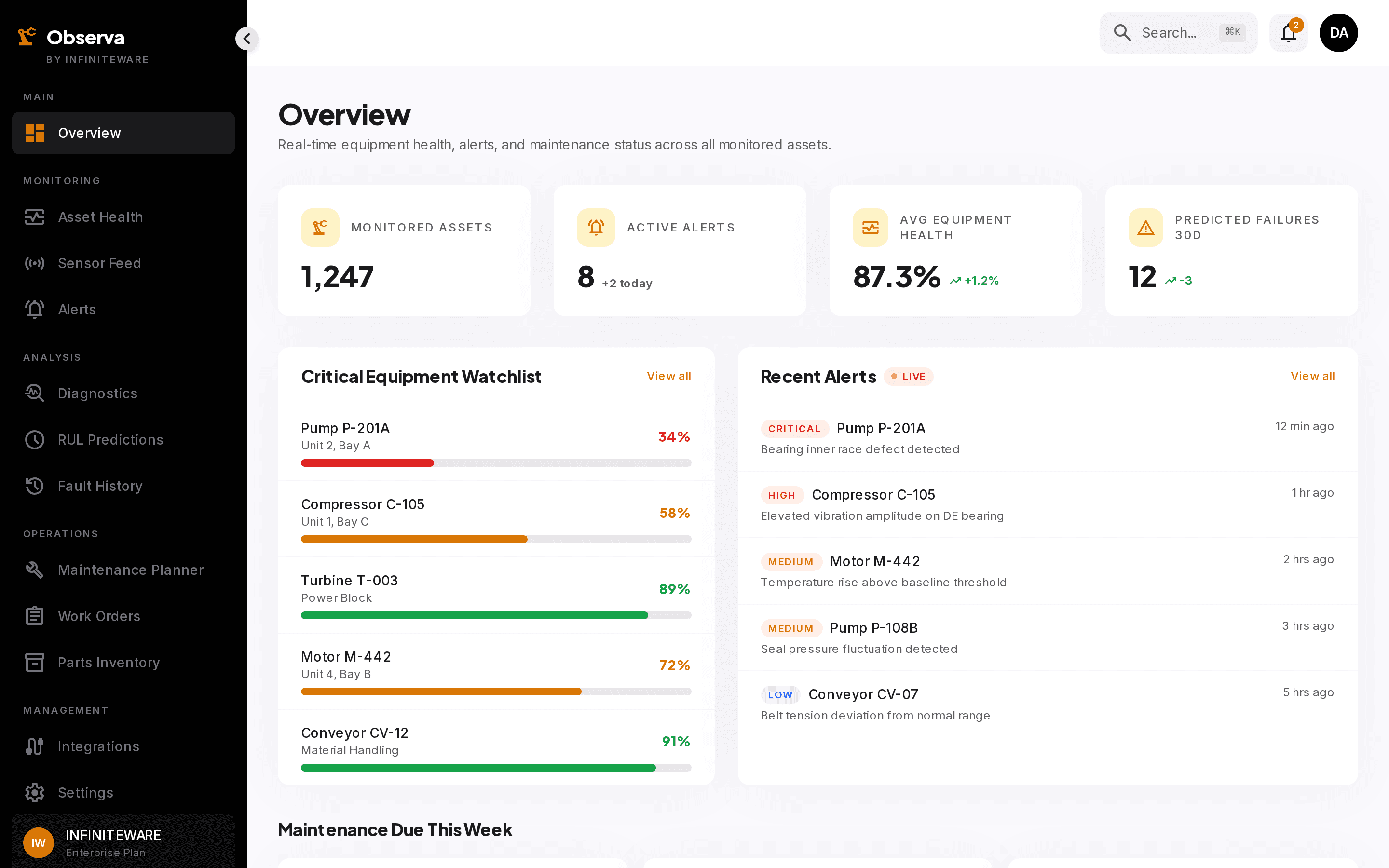
Every asset, every health score, on one screen.
The overview is the morning huddle in software form. Health scores, RUL trends, and active alerts roll up across every monitored asset, so reliability engineers know where to spend their day before they finish their coffee.
- Real-time fleet health roll-up across every monitored asset
- Active alerts grouped by severity and asset criticality
- RUL trend lines highlight assets accelerating toward failure
- Filter by site, line, asset class, or criticality with one click
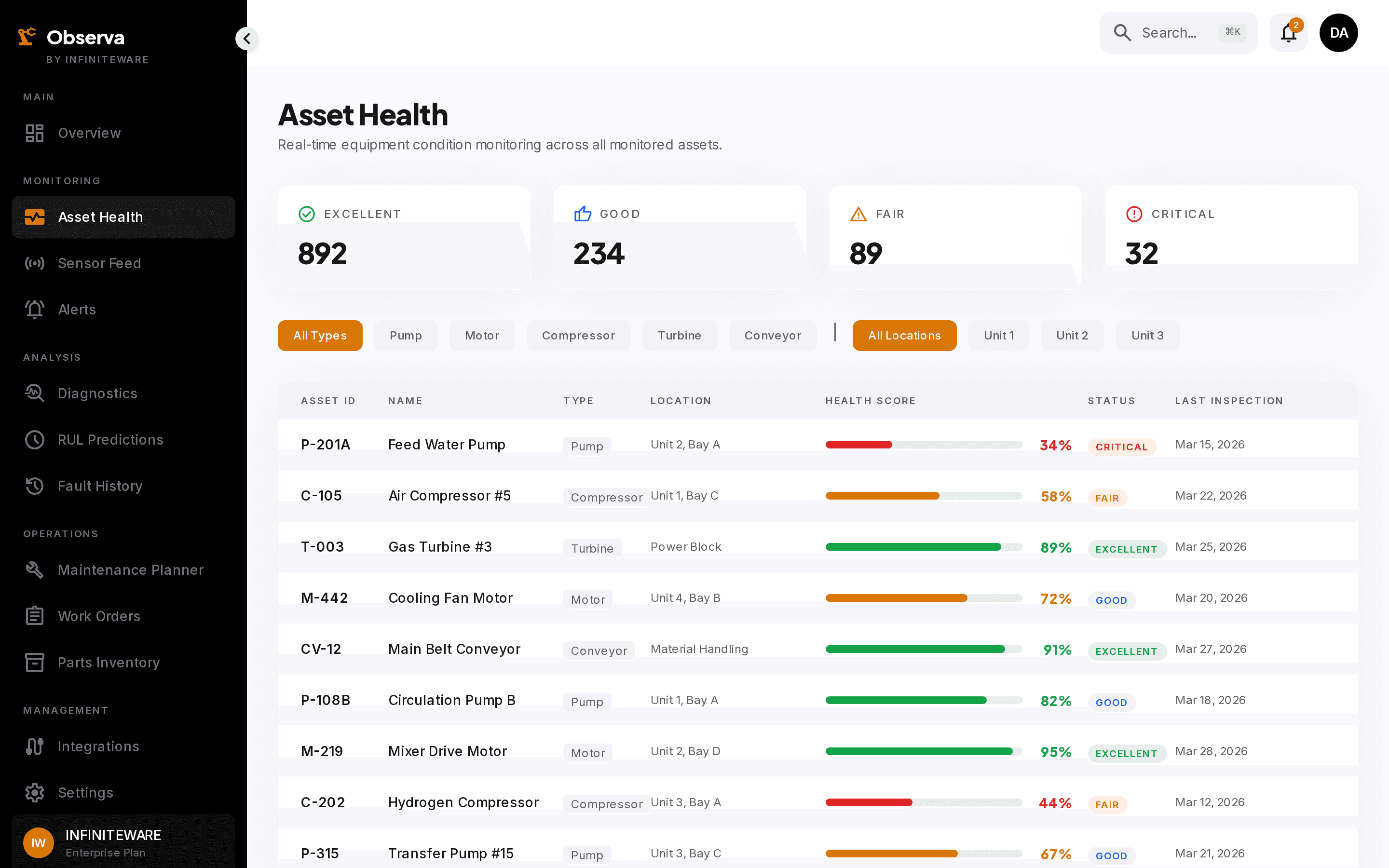
Your asset hierarchy, faithfully modelled.
Observa mirrors how your plant is actually organized: site, line, machine, component. Every asset carries its sensors, its baseline, its history, and its CMMS link, so context follows the work no matter where the conversation moves.
- Plant, line, asset, and component hierarchy out of the box
- Sensor mappings and tag aliases per asset
- Per-asset baselines that account for load and duty cycle
- Two-way CMMS linking so work orders and history stay in sync
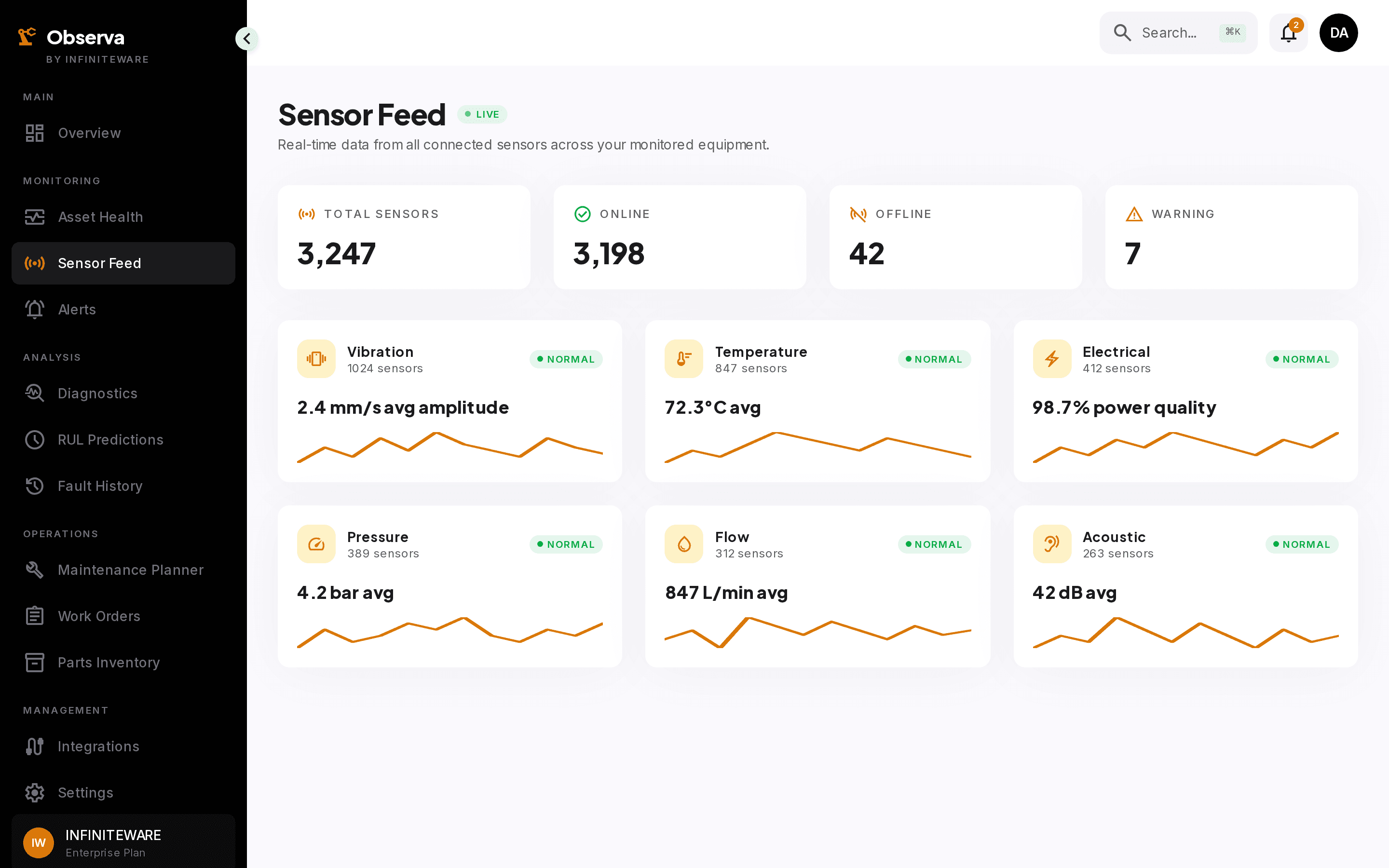
Vibration, thermal, current, acoustic, all together.
Sensor views are not channel silos. Observa correlates streams against each other and against the asset baseline so engineers see the relationships that matter, not just the numbers that move.
- Multi-channel time-series with synchronized cursors
- Spectral and envelope views for vibration analysis
- Baseline overlays show deviation in context
- Drill from fleet alert into raw waveform in two clicks
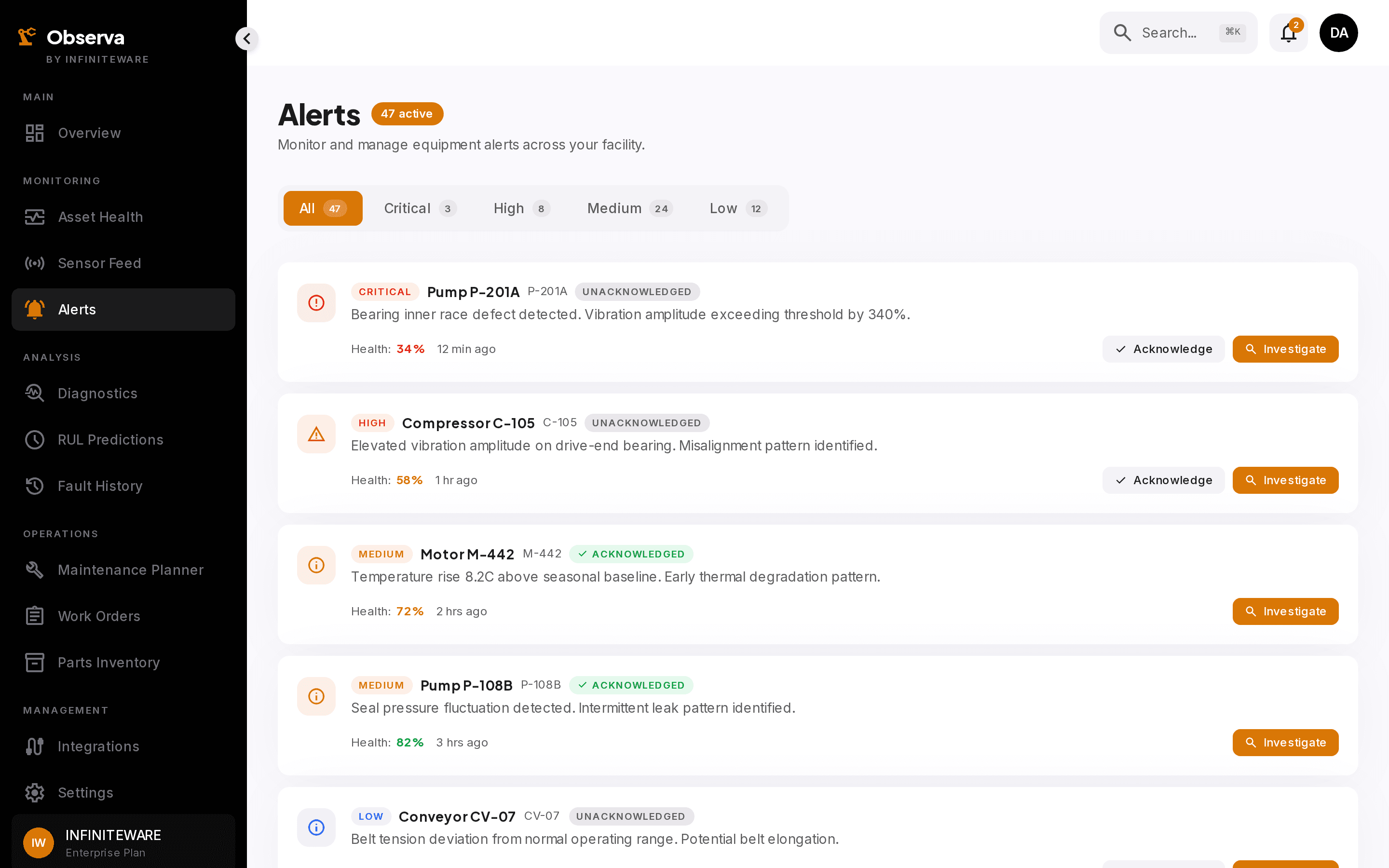
Specific faults, not vague warnings.
Threshold alarms tell you something changed. Observa tells you what is wrong: bearing inner race wear, soft foot, cavitation, stator imbalance. Each alert carries the evidence the model used so engineers can validate or override.
- Named fault diagnosis: bearing, alignment, balance, electrical
- Per-alert evidence trail of contributing sensor signals
- Engineer accept or reject feedback retrains the model
- Severity calibrated to asset criticality, not just signal strength
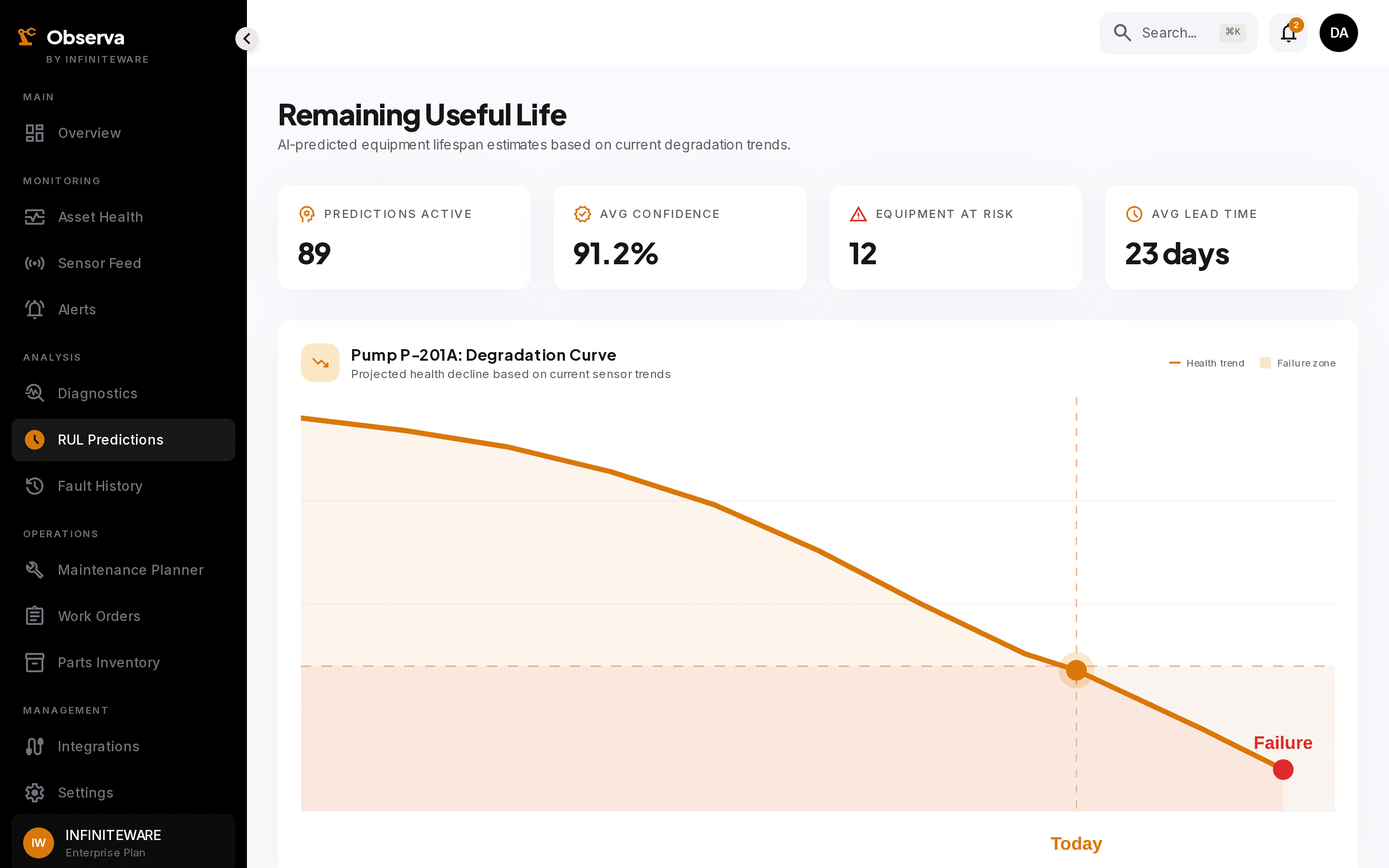
How long the asset has, with the math shown.
RUL is the bridge between detection and planning. Observa estimates remaining useful life in days for every faulted asset, with a confidence band and the degradation curve, so planners can sequence interventions without guessing.
- Per-asset RUL with confidence bands and degradation curve
- Updates as new sensor evidence accumulates
- Sortable RUL table for fleet-wide intervention planning
- Audit trail of how RUL has shifted over the past 90 days
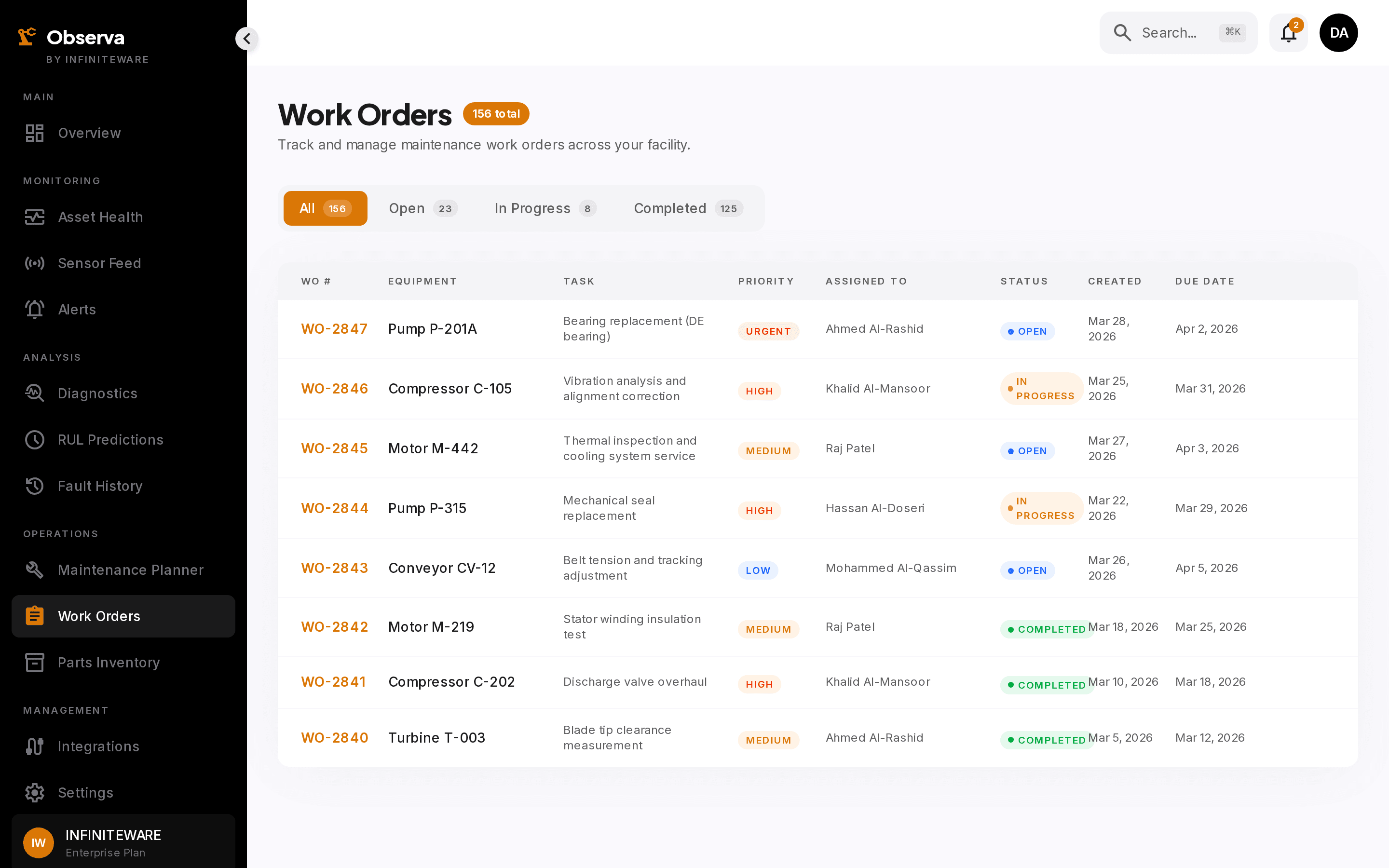
From confirmed fault to a planned, parts-ready job.
Approved alerts flow into work orders complete with the suspected fault, the procedure, the parts, and the priority. Observa hands planners a job that is already half-written, so the time between detection and wrench-on-bolt collapses.
- Auto-generated work orders with fault, parts, and procedure
- Priority tied to RUL and asset criticality
- One-click push to your CMMS of choice
- Closure feedback updates the model and the asset history
From smelters to production lines.
Observa adapts to the asset, not the other way around. The same physics-informed core powers both heavy industry and discrete manufacturing.
Pot-Line and Casthouse Reliability
Smelters live and die by uptime. Observa monitors casthouse cranes, pot-line rectifier transformers, fume treatment fans, and rod-mill drives, fusing vibration, thermal, and current signatures so reliability teams see degradation weeks before a forced outage.
- Casthouse and pot-line rotating equipment under one health view
- Fault diagnosis specific to transformers, fans, drives, and motors
- Work orders sequenced by RUL so planned outages stay planned
Production Line Motor and Pump Health
Production lines stop when one motor stops. Observa watches every critical drive, pump, and conveyor on the line, catches bearing wear and misalignment before they cascade, and writes the work order for next maintenance window.
- Per-line health rollup across every critical drive and pump
- Specific fault calls: bearing wear, misalignment, cavitation, imbalance
- Maintenance windows planned around RUL, not the calendar
Ready to stop chasing
unplanned downtime?
Request a DemoA typical pilot covers 50 to 100 critical assets and pays for itself on the first averted failure.