AI Agents Are a Trust Problem. Three Architectures That Help.
The bottleneck in AI adoption is not model capability, it is delegation. Here are the three team architectures we use at INFINITEWARE to keep stochastic LLMs predictable enough to ship into production.
Most "AI strategy" conversations start with the wrong question. Which model. Which framework. Which vendor. The conversation rarely starts where the actual blocker lives, which is trust.
You can plug a state-of-the-art model into a workflow tomorrow. The work that takes weeks is not connecting the model. It is deciding what you will actually let it do, and what guardrails make that safe.
Here is the line that lands every time we have this conversation with executives:
“If you cannot delegate to humans, you will not delegate to agents. AI is not solving your delegation problem. It is exposing it.”
Stochastic by design
The fundamental tension with LLMs is that they are stochastic. Same prompt, same model, slightly different output every call. For one-off creative tasks, fine, that is often the point. For workflows that touch revenue, regulatory filings, customer communication, or contracts, that randomness is the threat surface.
The instinct is to fix randomness by making the model bigger. That helps at the margins. The far larger lever is the architecture of the team around the model. How many agents. Who delegates to whom. Who checks whom. Where the human stays in the loop.
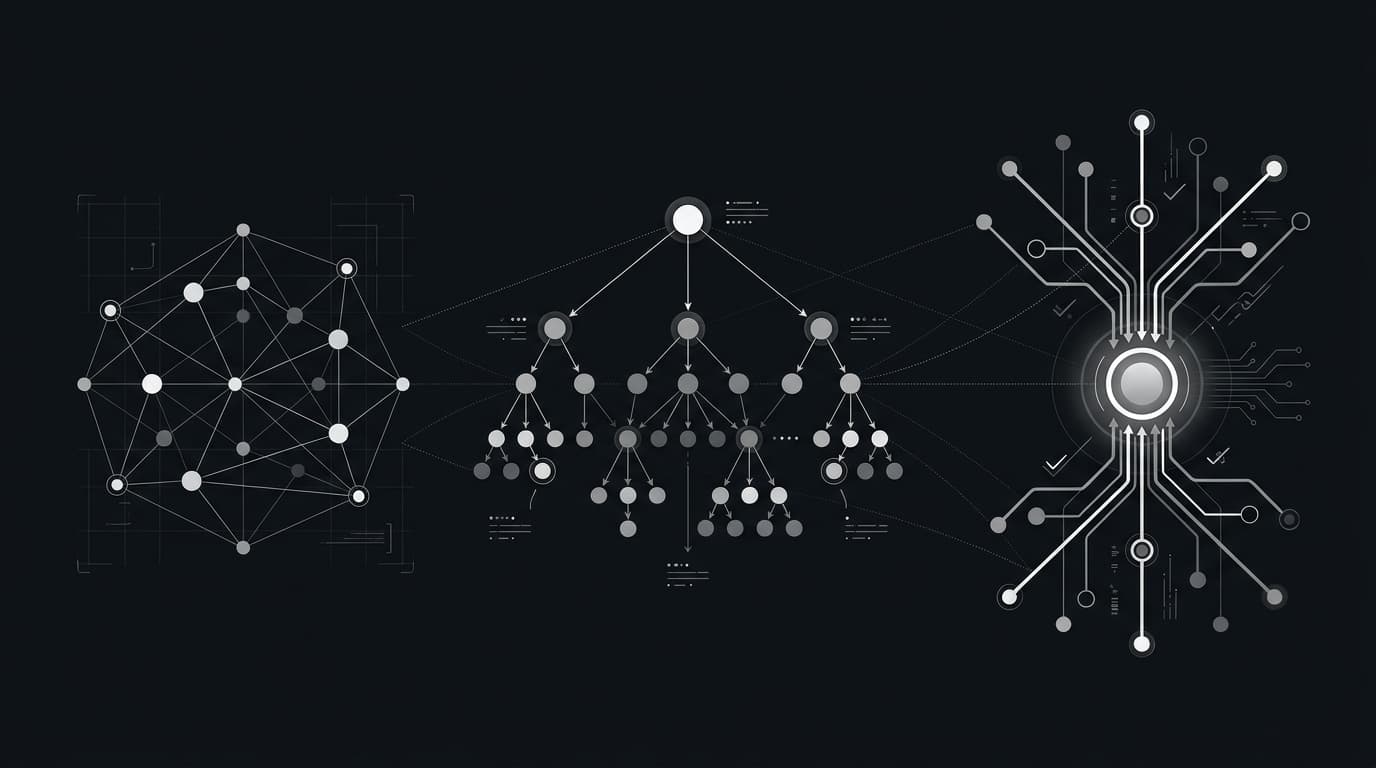
In production we have settled on three patterns. Each one trades cost, latency, and reliability differently. Choose wrong and your agent team spends its time arguing with itself. Choose right and the signal-to-noise compounds.
A. Flat / Peer Mesh
Several agents at equal authority. Each has a specialty (writer, researcher, summarizer, planner) but no one outranks the others. They share state, they each respond, and results either merge or fan out from there.
Cheap. High parallelism. Good coverage when the question is broad. Noisy at scale, because every agent has an opinion and no agent has final say. Use this when:
- You are exploring, not deciding
- A wrong answer is recoverable
- Latency matters more than precision
- You want breadth of perspective over depth of any one path
Examples in our work: research discovery across many sources, multi-source competitive scans, and brainstorm rounds before a proposal is committed to.
B. Deep / Nested Hierarchy
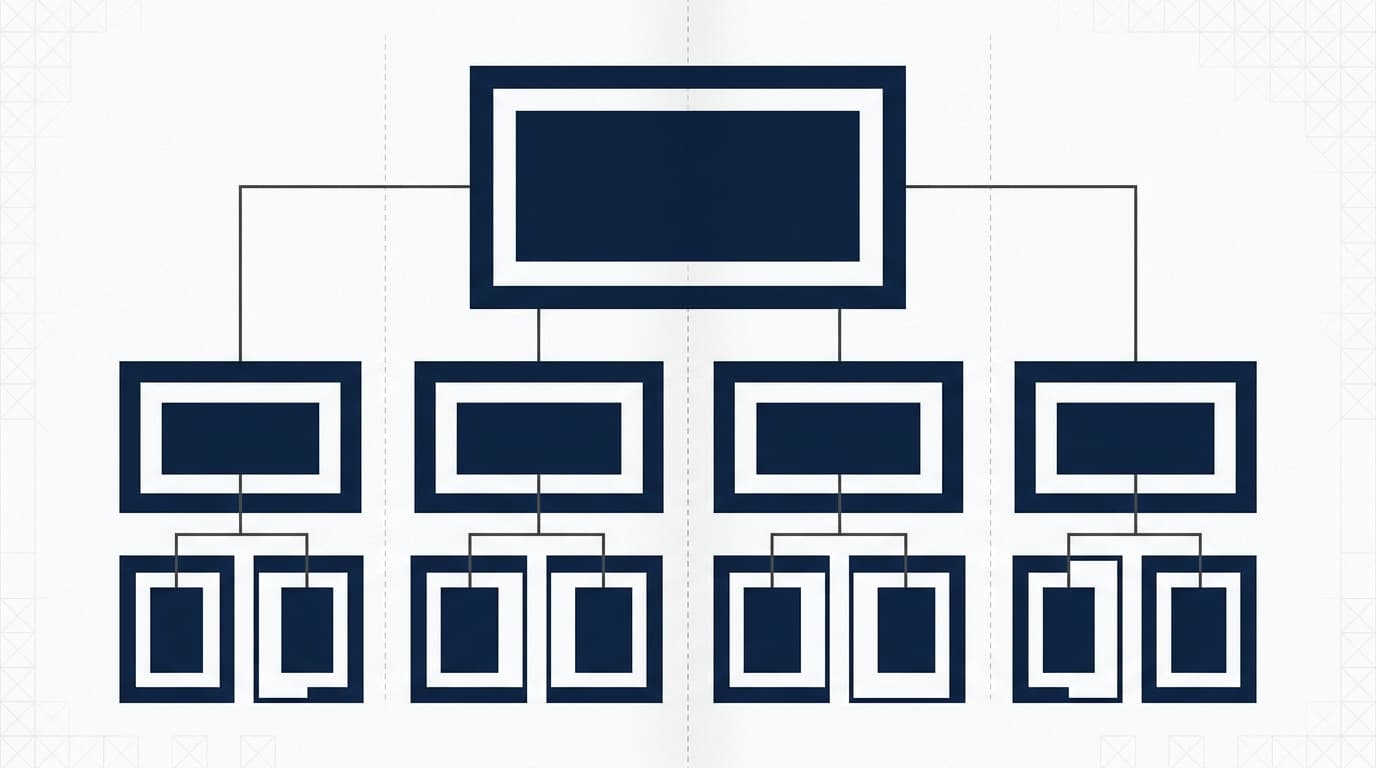
One lead agent owns the outcome. It decomposes the task and delegates pieces down to specialist agents, which can themselves delegate further. Output rolls back up the tree, reviewed at each level before it passes to the next.
Higher signal. Slower fan-out. Clear accountability at each step, because there is always a manager agent answering for the work below it. Use this when:
- The workflow has clear stages (intake, draft, review, finalize)
- Each step has a single right answer
- You can name the specialist roles ahead of time
Examples in our work: proposal generation from a discovery call, contract clause extraction, and financial-document classification. This is the architecture you reach for when you want predictability and you can afford the cost of the tree.
C. Quorum / Cross-Validation
Multiple agents independently produce an answer for the same question. A validator compares them. The result is accepted only if a quorum agrees, often with explicit confidence scoring per voter. Where they disagree, the system escalates to a human or invokes a stronger model to break the tie.
This is what Bitcoin figured out about trust, ported to LLMs. Do not trust one source. Require consensus.
Slower and more expensive. Two to five times the token spend per task. Worth it when the cost of a wrong answer beats the cost of compute. Use this when:
- Hallucination cost is high (legal, financial, medical, regulatory)
- The task has a single correct answer that multiple paths can converge on
- You need an auditable trail of who said what, and where they disagreed
Examples in our work: legal translation under audit, regulatory clause review, anything that could end up cited in a filing.
How to choose
A rough heuristic we keep close at hand:
- Recoverable error, breadth matters → Flat
- Production workflow, clear stages → Hierarchical
- High stakes, hallucination cost beats latency → Quorum
Do not pick the architecture first. Pick the failure mode you cannot afford. The architecture follows.
The mental shift
The hardest part of running an AI-native company is not technical. It is realising that your job, as the operator, is no longer to do the work. It is to design the system that does the work, and to know what good looks like when output shows up.
We have not built a pitch deck by hand in months. We have not drafted a proposal from scratch in longer. The work happens. We review. We rarely author.
That requires trust. Trust requires architecture. Architecture requires that you know your workflows well enough to decompose them.
This is the actual job now. The model picks itself.
“Build wrappers and you die. Build teams and you compound.”
Written by
INFINITEWARE Engineering
We are a Bahrain-based AI company shipping sovereign, on-premise systems for government, finance, energy, and legal across the GCC since 2008. Forty-plus clients. 19 products in production. We write here when we have something specific worth sharing from the work.